From mills to biscuit factories: Mumbai’s industrial legacy gives way to real estate redevelopment
Mumbai real estate: The Parle-G factory in Vile Parle is the industrial site the company plans to redevelop into a commercial complex
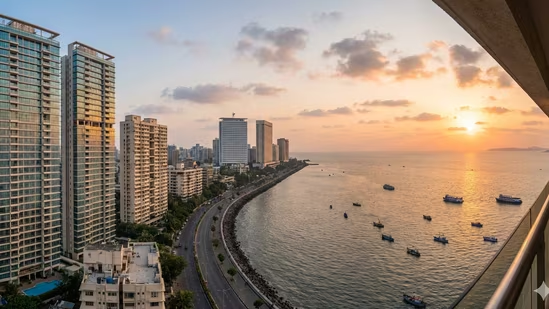
Mumbai’s skyline is gradually being reshaped by the reinvention of its industrial past. Across the city, old textile mills, factories, and once-iconic commercial structures are giving way to gleaming luxury residences and premium office developments, as land-starved Mumbai squeezes fresh value from its legacy assets. From shuttered cotton mills in Central Mumbai to former manufacturing hubs in the suburbs, industrial land that once powered the city’s economy is now being monetised to fuel its next phase of urban growth.
The latest chapter in this transformation features the iconic Parle-G biscuit factory in Vile Parle. Long a symbol of India’s FMCG success story, the Parle Products manufacturing campus has seen portions of its land redeveloped over the years as production gradually moved elsewhere and real estate values soared.
While Parle Products continues operations at other locations, its Mumbai footprint has steadily evolved. The company now plans to redevelop its oldest manufacturing premises in Vile Parle East, where India’s most recognisable biscuit was born, into a commercial complex, according to a Hindustan Times report.
The Parle land parcel spans 5.44 hectares (13.45 acres) and is proposed to be redeveloped with a built-up area of 1,90,360.52 sq m. This includes 1,21,698.09 sq m under Floor Space Index (FSI) and 68,662.43 sq m as non-FSI construction. The estimated project cost is pegged at ₹3,961.39 crore, according to the report.
Each of the four proposed buildings will have two basement levels. The A-wing of the first three buildings is proposed to have six floors. For Building 1, the B-wing will be partially commercial, with the first, seventh and eighth floors earmarked for shops and offices, while floors two to six are proposed for parking. The commercial compound is expected to include retail outlets, restaurants and food courts, the report said.
From mills to mixed-use: Mumbai’s industrial legacy reimagined
Some of Mumbai’s most prominent redevelopment stories are rooted in the city’s historic mill belt of Central Mumbai, Lower Parel, Worli, Mahalaxmi and Prabhadevi, where dozens of textile mills that once powered Bombay’s economy have been transformed into premium real estate landmarks.
This shift began in the 1990s, as the textile industry declined, and gathered pace following changes in development control regulations that unlocked the redevelopment potential of these large land parcels. Iconic mills such as Phoenix Mills, Kamala Mills, Lower Parel Mills, Bombay Dyeing Mills, Sitaram Mills, Spring Mills, and India United Mills have since given way to a new urban fabric of office towers, luxury residences, malls, and hospitality projects. Phoenix Mills, in particular, has emerged as a defining mixed-use destination, anchored by High Street Phoenix and complemented by commercial offices and hotels, say experts.
The reinvention has extended well beyond textiles. Across Andheri, Kurla, Goregaon and Mulund, former biscuit factories, engineering units and warehouses have been repurposed into IT parks, co-working hubs and residential developments, mirroring Mumbai’s broader shift from manufacturing to services-led growth.
Looking ahead, the redevelopment of railway land, Mumbai Port Trust land along the eastern waterfront, and salt pan parcels in the suburbs is expected to unlock the next wave of large-scale real estate opportunities, reshaping the city’s urban landscape over the coming decade, say experts.
What is redevelopment?
In Maharashtra, several old buildings, particularly those comprising two to seven storeys, are currently undergoing redevelopment. Redevelopment of housing projects involves demolishing the existing structure and replacing it with a modern, larger building, subject to various regulations.
The residents of the old building receive larger apartments in the new building for free, while the builder sells a certain number of apartments in the new building at a profit in the open market. The government also earns revenue through stamp duty, registration fees, and other direct and indirect taxes.
Experts say land monetisation is expected to continue in Mumbai
According to experts, the land-starved city of Mumbai will continue to see land being monetised by factory owners in the coming years.
“The first wave was mill land, and that was followed by factories, manufacturing units, and industrial plots. There are countless examples of these land parcels making way for prime real estate, and this will continue in the coming years,” Shankar Prasad, a real estate consultant from Mumbai’s Western Suburbs, said.
With infrastructure in satellite cities near Mumbai catching up, the trend will pick up in the years to come, experts said.
“Several government institutions are also monetising land in the open market, and this trend is expected to continue as satellite cities around Mumbai develop better infrastructure for industries, businesses, warehousing, and logistics. It no longer makes economic sense for these activities to remain within the city; they can relocate to the outskirts, acquire land at much lower costs, and monetise their Mumbai holdings,” Prasad added.
Share this content:












Post Comment